
Fungal contamination spreads fast once moisture takes hold. If spores are colonizing behind drywall, creeping through basement walls, or circulating inside HVAC ducts, the situation becomes urgent. House mold removal cost depends on where the problem is, how far it has spread, and what materials need replacing. Most homeowners pay between $500 and $6,000 for professional mold remediation, though severe cases push well past $10,000. This guide breaks down real-world pricing, explains what drives the bill higher, and walks through every step of the cleanup so you can budget with confidence.
What Affects Mold Remediation Cost
The final price tag depends on specific variables. Mold remediation cost is not one-size-fits-all. A small patch of surface contamination on bathroom tile bears no resemblance to a full basement mold infestation that has eaten into floor joists.
Here are the factors professionals evaluate before quoting a job:
- Square footage affected – A mold problem covering less than 10 square feet often qualifies as a minor job. Anything beyond that requires containment barriers and HEPA filtration.
- Location within the structure – Attic contamination, crawl space colonies, and wall cavity infestations each demand different access methods. Tight spaces like ductwork and crawl areas add labor hours.
- Surface and material type – Hard, non-porous surfaces (tile, glass, metal) are simple to clean. Porous materials like drywall, wood framing, carpet, and insulation usually need full replacement.
- Type of mold present – Not all species behave the same. Stachybotrys chartarum, commonly called black mold, requires stricter safety protocols than surface-level Cladosporium or Penicillium. Aspergillus species fall somewhere in between depending on the strain.
- Root cause – A one-time pipe leak is cheaper to resolve than chronic humidity from poor ventilation or ongoing water damage from a failing roof.
- Extent of the contamination and how long it has been growing – Fungal colonies that have spread for months penetrate deeper into building materials. That means more demolition and more reconstruction.
The contractor’s approach matters too. Some remediation companies include post-cleanup air quality testing in their base rate. Others charge it separately. Always ask what the estimate covers before signing.
Average Cost of Mold Remediation by Location
Where the problem lives inside your property is the single biggest factor in how much it costs. Each area of a home presents different challenges for access, containment, and material replacement. Remediation costs vary significantly based on which room or zone is affected.
- Bathroom: $500 to $1,500. Tile and grout contamination is the easiest scenario. Prices climb if spores have reached behind the shower surround or into subfloor material.
- Attic: $1,500 to $3,500. Removing mold from an attic often means replacing insulation, treating wood sheathing, and improving ventilation to prevent regrowth. Limited workspace and wiring make this job slower. Learn more about recognizing musty odors that signal hidden attic problems.
- Basement: $2,000 to $6,000. Basements trap moisture naturally. Concrete walls wick water from surrounding soil, and poor airflow lets humidity stay elevated. Widespread basement infestations frequently involve both walls and flooring.
- Inside walls: $1,000 to $5,000. Contamination inside walls requires opening up drywall, treating the framing, and rebuilding. The expense depends on how many linear feet the area affected by mold covers.
- HVAC system: $3,000 to $8,000. Duct cleaning alone runs $500 to $2,000, but if fungal colonies have reached the air handler, furnace coils, or return plenums, the rate escalates fast. A contaminated HVAC system can spread spores to every room.
- Crawl space: $2,000 to $6,000. Crawl space infestations are common in humid climates. Treatment typically includes removing contaminated vapor barriers, treating joists, and installing a dehumidifier.
- Whole-property project: $10,000 or more. When multiple zones are involved, crews may need several days of containment and phased cleanup.
The EPA recommends professional intervention for any affected area larger than 10 square feet. Below that threshold, a capable homeowner can sometimes handle the job with proper safety gear.
How Much Does Mold Remediation Cost Per Square Foot
Many contractors quote per square foot for larger projects. Expect to pay between $10 and $25 per square foot for standard remediation. High-risk species or hard-to-access locations push rates toward $25 to $40 for each square foot.
For a 200-square-foot basement infestation at $20 a square foot, the bill comes to roughly $4,000 before any structural repairs. Add drywall replacement, insulation, and painting, and the total can double.
Per-unit pricing helps when comparing bids. But watch out for estimates that exclude disposal fees, containment setup, or post-treatment testing. Those line items can add 15% to 30% to the bottom line.
Mold Remediation in an Apartment: What Renters Should Know
Mold remediation in an apartment typically runs between $1,000 and $4,000 for a single unit. The scope depends on severity and whether shared systems are involved. A building with a central HVAC system presents a bigger challenge because spores can migrate through ductwork into neighboring units.
Renters often wonder who pays. In most states, landlords bear responsibility for maintaining habitable conditions. If contamination results from a structural issue like a leaky roof or broken pipe, the landlord generally covers the remediation. Tenant-caused moisture problems, such as never running the bathroom exhaust fan, may shift some liability.
Document everything. Photograph the affected area, note any unusual smells, and submit written maintenance requests. If your landlord refuses to act, contact your local housing authority.
What Does the Mold Remediation Process Include
A licensed remediation company follows a structured sequence to remove contamination safely. Cutting corners on any step risks recontamination within weeks. Here is what a thorough job looks like:
- Inspection and testing – A qualified inspector evaluates visible contamination and checks for hidden colonies using moisture meters, thermal imaging, and sometimes air sampling. This step often runs $200 to $600 on its own. Our guide on inspection pricing covers this in detail.
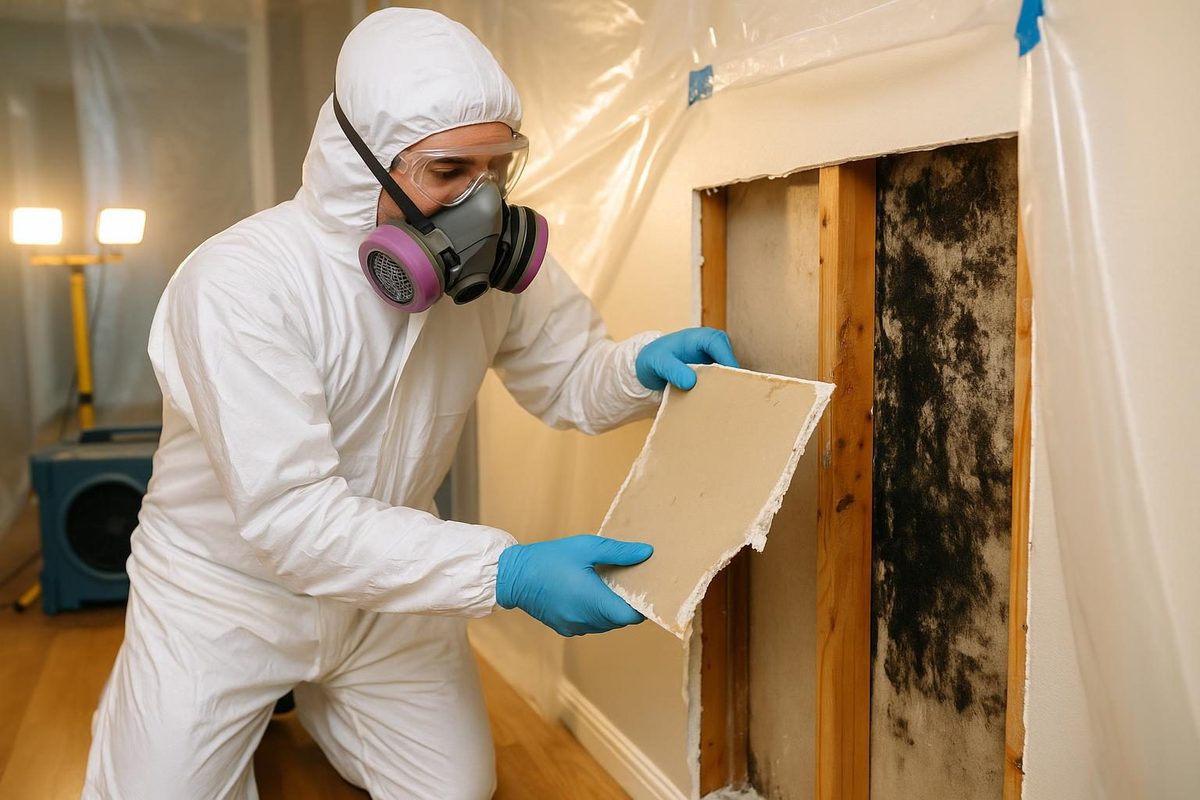
- Containment – Workers seal off the affected zone with plastic sheeting and negative air pressure machines fitted with HEPA filters. This helps prevent spores from spreading to clean areas of the home.
- Removal of contaminated materials – Damaged drywall, insulation, carpet, wallpaper, and any other porous material that cannot be salvaged gets cut out and bagged for disposal. Crews wear personal protective equipment including respirators, gloves, and coveralls.
- Cleaning with antifungal agents – Remaining surfaces are scrubbed thoroughly. Wood framing often gets sanded and treated with antimicrobial sealant. HEPA vacuuming captures residual spores.
- Drying and ventilation – Industrial dehumidifiers and air movers run for 24 to 72 hours to bring moisture levels below the threshold where regrowth can occur. Target indoor humidity: under 50%.
- Post-treatment verification – Air sampling confirms spore counts have returned to normal background levels. Reputable firms include this step or offer it as an add-on.
- Reconstruction – Replacing drywall, reinsulating, and finishing the repaired area. Some companies handle this in-house. Others subcontract it.
The entire process takes anywhere from one day for a small bathroom job to two weeks for a whole-property project. Homeowners can often stay in the home during minor work, but extensive remediation may require temporary relocation.
Black Mold Removal: Why It Typically Costs More
Stachybotrys chartarum, the species most people mean when they say “black mold,” produces mycotoxins that pose genuine health risks. Prolonged exposure can trigger respiratory disease symptoms, allergic reactions, chronic sinus infections, and skin irritation. People with asthma or weakened immune systems face higher risk.
Black mold removal requires Level 3 containment protocols: full-face respirators, disposable coveralls, decontamination chambers between the work zone and clean areas, and independent air monitoring. These precautions add $1,000 to $3,000 on top of standard remediation fees.
Not every dark-colored fungus is Stachybotrys. Cladosporium and Aspergillus can also appear dark green or black. Professional testing identifies the actual species before anyone commits to the higher-tier cleanup protocol. Spending $300 on lab analysis can save thousands if the contamination turns out to be a less hazardous strain.
DIY Mold Removal vs. Professional Mold Removal Services
Small patches on non-porous surfaces, think mildew on tile grout or a discolored spot on a windowsill, can be handled with household supplies. White vinegar, hydrogen peroxide, or commercial antifungal sprays work well. Keep the area ventilated, wear gloves and a respirator rated N-95 or better, and dispose of cleaning materials in sealed bags.
That said, most infestations go beyond what DIY can fix. Here is where the line sits:
- DIY is reasonable when the affected zone is less than 10 square feet, on a non-porous surface, and you can see the full extent of the contamination.
- Call a professional when contamination covers more than ten square feet, extends behind walls or under flooring, involves HVAC components, or you detect a persistent musty odor without visible growth.
- Never attempt DIY on suspected Stachybotrys (black colonies with a slimy or wet texture). Disturbing these colonies without proper containment releases massive spore loads into your indoor air.
One mistake I see repeatedly: homeowners paint over visible contamination thinking it solves the problem. It does not. The fungus keeps growing beneath the paint film, and within months the discoloration bleeds through again. Worse, the underlying moisture issue goes unaddressed.
Does Homeowners Insurance Cover Mold Removal?
Standard homeowners policies cover remediation only when the contamination results from a “covered peril,” meaning a sudden, accidental event like a burst pipe or storm damage. Gradual leaks, long-term humidity problems, and deferred maintenance almost never qualify.
Some policies include a sub-limit for fungal damage, typically $5,000 to $10,000. Others exclude it entirely. Review your policy language or call your agent. If contamination resulted from a covered water event, file the claim promptly and document all damage thoroughly.
Flood insurance through the National Flood Insurance Program does not cover these expenses at all. If your area is flood-prone, budget for this separately.
How to Prevent Mold Growth and Reduce Future Expenses
Preventing regrowth after cleanup is just as important as the initial treatment. The conditions that allowed fungal colonies to establish, excess moisture, inadequate ventilation, organic material in contact with dampness, will produce the same result again if left unchanged.
Practical steps that actually work to prevent mold:
- Fix leaks within 24 to 48 hours. Water from a roof leak, pipe failure, or appliance malfunction needs immediate attention. Fungal colonies can establish within 48 hours on wet surfaces.
- Maintain indoor humidity below 50%. A quality dehumidifier in the basement or crawl space makes a measurable difference. Monitor levels with a $15 hygrometer.
- Run exhaust fans during and after showers. Bathroom humidity spikes feed surface contamination on grout, caulk, and ceiling paint.
- Improve attic ventilation. Ridge vents, soffit vents, and powered attic fans help prevent fungal growth on sheathing during temperature swings.
- Insulate cold-water pipes and air conditioning supply ducts. Condensation on these surfaces creates the exact conditions fungi need.
- Clean gutters and grade soil away from the foundation. Water pooling near the foundation wall eventually migrates into basement and crawl space areas.
- Inspect problem-prone areas twice a year. Catching contamination early, before it spreads into wall cavities or structural framing, saves significant money.
These preventive measures represent a fraction of what a full remediation project would run. Spending $200 on a dehumidifier beats a $6,000 basement cleanup.
How Long Does Professional Mold Remediation Take?
Timeline depends on scope. A straightforward bathroom project wraps up in one to two days. A full basement or attic job takes three to five days. Whole-property projects involving multiple contamination zones can stretch to two weeks.
Several factors extend the schedule:
- Discovery of additional contamination behind walls or under flooring during demolition
- Slow dry-out times in humid weather or in structures with poor airflow
- Waiting for post-treatment air quality test results before beginning reconstruction
- Material back-orders for specialty drywall, insulation, or vapor barriers
Ask your contractor for a realistic timeline upfront, not just a best-case estimate. Rushed jobs that skimp on drying time often lead to recontamination within months.
Choosing a Mold Remediation Company: Red Flags and Green Lights
The remediation industry is not uniformly regulated. Some states require specific licensing for fungal abatement. Others allow general contractors to perform the work. That inconsistency means the burden of vetting falls on the homeowner.
Green lights:
- Carries certifications from the IICRC (Institute of Inspection, Cleaning and Restoration Certification) or ACAC (American Council for Accredited Certification)
- Provides a written scope of work before starting
- Includes post-treatment air testing or recommends an independent third-party test
- Offers a warranty on the remediation work
- Willing to explain their containment and disposal process in plain language
Red flags:
- Quotes a price before inspecting the property
- Uses scare tactics about “toxic contamination” to inflate the estimate
- Performs both the initial testing and the cleanup (conflict of interest)
- Refuses to provide references or proof of insurance
- Recommends unnecessary “fogging” treatments as a standalone solution
Get at least three written bids. The cheapest option is rarely the best value when structural integrity and indoor air quality are at stake.
Health Risks of Exposure to Mold
Ignoring a mold issue does not save money. It shifts the expense from remediation to medical bills, property damage, and diminished resale value. Indoor contamination can cause serious health problems when spores circulate through indoor air for extended periods.
Common health effects from prolonged exposure include:
- Allergic rhinitis (sneezing, runny nose, itchy eyes)
- Asthma flare-ups and new-onset wheezing
- Chronic sinus infections
- Skin rashes and irritation
- Respiratory infections in immunocompromised individuals
Children, elderly adults, and anyone with pre-existing respiratory disease face the highest risk. The CDC notes that no amount of indoor fungal growth is considered safe, and the health effects of exposure vary widely between individuals.
From a property standpoint, unaddressed contamination keeps eating into organic building materials: wood framing, paper-faced drywall, carpet backing, and even furniture. Serpula lacrymans, the dry rot fungus, can compromise structural timber within months if moisture levels remain high.
Final Thoughts on House Mold Removal Cost
The average cost of mold remediation falls between $500 and $6,000 for most residential projects, but extensive infestations involving structural repair can exceed $10,000. Per square foot, expect $10 to $25 for standard work and $25 to $40 for high-risk species. Removal costs climb when walls, HVAC systems, or crawl spaces are involved.
Ignoring a mold problem always makes it worse. Fungal colonies do not stop spreading on their own, and the longer you wait, the more material gets destroyed and the higher the final bill climbs. If you worry about mold in your home, schedule an inspection, get multiple written bids, and address the moisture source before any cleanup begins. That sequence, inspect first, fix the water, then remediate, is the only approach that delivers lasting results. House mold removal cost varies, but acting early always reduces the total investment.
Frequently Asked Questions
How much does mold remediation cost for an entire property?
Whole-property remediation typically starts around $10,000 and can exceed $30,000 for severe cases involving structural repair, HVAC cleaning, and multi-zone containment. The actual figure depends on total square footage affected and the species present.
Can mold be completely removed from a structure?
Spores exist naturally in outdoor air, so completely eliminating every one is impossible. The goal of professional remediation is returning indoor spore counts to normal background levels and removing all visible colonies. Addressing the moisture source prevents regrowth.
Is it expensive to get rid of mold?
Minor surface problems can be resolved for $300 to $500, sometimes as a DIY project. Larger infestations involving porous materials, wall cavities, or HVAC systems run $2,000 to $8,000 or more. The expense reflects containment equipment, labor, materials, disposal, and reconstruction.
What kills mold permanently?
No chemical spray provides a permanent solution on its own. Effective treatment combines physical removal of contaminated material, antifungal cleaning of remaining surfaces, thorough drying, and elimination of the moisture source. Without fixing the underlying water or humidity problem, regrowth is inevitable.
Can I stay home during the remediation process?
For small, contained projects, yes. Proper containment with negative air pressure and HEPA filtration keeps the living space safe. For extensive work spanning multiple rooms or involving HVAC systems, temporary relocation is strongly recommended, especially for households with young children, elderly residents, or anyone with respiratory conditions.
How do I choose between mold remediation companies?
Verify IICRC or ACAC certification, check online reviews and references, confirm they carry liability insurance, and compare at least three written bids. Ask whether post-treatment air testing is included. Avoid firms that perform both the initial inspection and the remediation, as that creates a conflict of interest.
What factors affect mold removal pricing the most?
Square footage of the affected area, accessibility, species present, and the extent of structural damage are the four biggest variables. HVAC involvement and the need for post-cleanup reconstruction also significantly influence the total bill.
